Pet Toy Manufacturers in Southeast Asia: Vietnam, Thailand & Indonesia Compared (2026)
Pet Toy Manufacturers in Southeast Asia: Vietnam, Thailand & Indonesia Compared (2026)
Finding the right pet toy manufacturer in Southeast Asia - whether in Vietnam, Thailand, or Indonesia - is one of the most consequential decisions a growing pet brand can make in 2026. With tariffs on Chinese goods still volatile and retailer diversification requirements tightening, Southeast Asia has become the primary alternative manufacturing region for US and EU buyers. This guide breaks down exactly which country fits which product category, what compliance looks like today, and how to qualify suppliers that will actually hold up under retailer scrutiny.
The global pet toy market is valued at roughly $9.6–10.2 billion in 2025–2026, with projections reaching $16–18 billion by 2030–2034. This growth is driven by pet humanization - the documented shift of consumers spending on animals the same way they do for children. Dog toys dominate revenue, with chew toys as the leading subcategory.
Why Pet Toy Brands Are Leaving China for Southeast Asia
For decades, Chinese factories handled the bulk of this production - Pingyang County alone accounted for around 60% of global dog chew output. That concentration no longer makes sense for most brands.
Three forces are driving the shift to Southeast Asian pet toy manufacturing.
Tariff risk on Chinese goods. China currently operates under a temporary 15% US tariff rate. New Section 301 investigations launched in March 2026 could increase that further. The tariff advantage of sourcing from Southeast Asia over China remains real, but the gap has narrowed and the policy environment is volatile.
Supply chain dependency. COVID-19 supply chain failures exposed the cost of single-country dependency when production froze - a lesson that still shapes how brands operate today.
Retailer pressure. Major US buyers continue to require vendor diversification as a supply chain resilience condition.
The China+1 sourcing strategy remains a board-level priority - though brands need to understand that the tariff picture for Southeast Asia itself changed dramatically in 2025 and is still evolving.
Three broader trends shape sourcing decisions in this market: e-commerce drives roughly half of all pet toy purchases globally, making packaging and labeling compliance as critical as the product itself. Smart and connected pet toys are growing fast - the pet tech segment is projected at $52.9 billion by 2035. And sustainability has become a genuine purchase driver, with 55% of pet owners reporting that eco-friendliness influences their buying decisions.
Vietnam vs Thailand vs Indonesia: Choosing the Right Pet Toy Manufacturer
The most common sourcing mistake in Southeast Asia is treating the region as a single option. Vietnam, Thailand, and Indonesia have fundamentally different manufacturing strengths - different raw materials, labor cost profiles, and factory infrastructure. Matching your product category to the right country matters as much as factory selection. This is the core of how Play Trail structures its supplier matching process - country selection comes before factory outreach, not after.
Vietnam Pet Toy Manufacturers: Best for High-Volume Plush, Rope, and Rubber Toys
Vietnam is the logical starting point for most pet toy brands. Trade data identifies 214 active pet toy suppliers shipping to 441 global buyers, accounting for approximately 6% of worldwide pet toy shipments - second only to China. The US takes 58% of Vietnam's pet toy exports, meaning the manufacturing infrastructure is already calibrated to American retailer standards.
Manufacturing Costs and Labor Rates
Manufacturing labor averages $294–321/month - roughly half of comparable Chinese wages. Trade agreements including CPTPP, RCEP, and the EU-Vietnam FTA deliver 0% tariffs on many toy categories into the EU. Vietnam is also the third-largest natural rubber producer globally, which is directly relevant for latex and rubber toy lines.
US Tariff Rates for Vietnamese Pet Toys
The current US tariff rate is 10% Section 122, stacked on MFN rates. The bilateral framework sets a 20% baseline once Section 301 investigations resolve - still significantly below China's effective rate.
Main Production Hubs
Binh Duong, Dong Nai, and Ho Chi Minh City handle plush, rope, rubber, and plastic toys. Hai Phong and Hai Duong cover higher-volume plastic manufacturing.
The factory ecosystem is more developed here than anywhere else in the region. Leading Vietnamese exporters operate multiple facilities with 1,000+ employees and serve dozens of international brands including major US retailers. Several large Chinese pet manufacturers have established Vietnam facilities as their core overseas production base - a signal of how seriously the export-oriented manufacturing environment here is taken.
Vietnam Pet Toy Supplier Limitations
Heavy dependence on Chinese raw materials remains a vulnerability, and the US has made anti-transshipment provisions a specific focus of the bilateral framework - products with significant Chinese content face a 40% rate. Quality variation between top-tier export factories and smaller suppliers is also significant. The gap between a factory's sales presentation and its actual quality management capability is wider here than buyers typically anticipate.
Play Trail's supplier network in Vietnam is built around factories that have been verified through on-the-ground audits rather than trade directory listings - the distinction matters more in Vietnam than most buyers realize until they've had a problem.
Best fit for: Plush toys, rope toys, rubber toys, plastic pet toys, high-volume production.
Thailand Pet Toy Manufacturers: Best for Natural Rubber, Latex, and Premium Products
Thailand produces roughly 36% of global natural rubber output - approximately 4.85 million metric tons annually - making it the world's largest natural rubber producer. For latex chew toys, rubber fetch toys, or any rubber-based pet product, this raw material advantage is unmatched in the region.
Natural Rubber Advantage for Pet Toy Manufacturing
Thailand is also the world's second-largest pet food exporter, with pet food exports exceeding $2.7 billion in 2024 and a domestic pet market that grew 17.5% annually from 2019 to 2024. The infrastructure built around pet food manufacturing has created strong adjacent capability in toys and accessories.
Several of Southeast Asia's largest producers of rawhide chews, rubber dog toys, and latex dog toys are based in Thailand - ISO 9001 certified and exporting to Asia, Europe, and North America. A number of well-known European pet brands with premium and B Corp positioning source their rubber product lines from Thailand, which is a reasonable signal of the manufacturing quality ceiling here. Introductions to the right factories in this segment aren't something a cold trade directory search reliably surfaces - most of the better operators here work through established referral relationships.
Tariff and Cost Profile
Manufacturing labor averages around $412/month - higher than Vietnam. The US bilateral framework sets a 19% tariff baseline for Thailand, with current 10% Section 122 tariffs in place until approximately July 2026. Thai exports to the US rose 23% in 2025 despite the tariff environment, reflecting sustained demand. Thailand's Commerce Ministry has flagged expectations of slower export growth in 2026 as tariff impacts become clearer.
Best Pet Toy Categories to Source from Thailand
Thailand's raw material base makes it the strongest option in the region for any rubber-intensive product line. Natural rubber from Thai suppliers is renewable, biodegradable, and inherently free of BPA and phthalates - a compliance and sustainability advantage that adds genuine value for brands positioning in premium retail.
Best fit for: Natural rubber toys, latex chew toys, premium pet products, rubber-intensive product lines.
Indonesia Pet Toy Manufacturers: Best for Natural, Artisanal, and Sustainable Materials
Indonesia's pet toy manufacturing story differs from the other two countries. Export volume and infrastructure for high-volume pet toy production are still developing. What Indonesia offers instead is a differentiated material palette unavailable at scale anywhere else in the region.
Unique Natural Materials for Pet Toys
Materials available from Indonesian manufacturers include coffee root (yes, the root of the coffee tree), liana vines, kasela vines, bamboo, coconut fiber, and reclaimed rubberwood. Established Indonesian manufacturers produce pet toys from these materials, with the better operators holding SVLK timber legality certification and provisional World Fair Trade Organisation membership - verifiable supply chain credentials rather than marketing claims.
Coffee Wood Chew Sticks: A Sourcing Opportunity
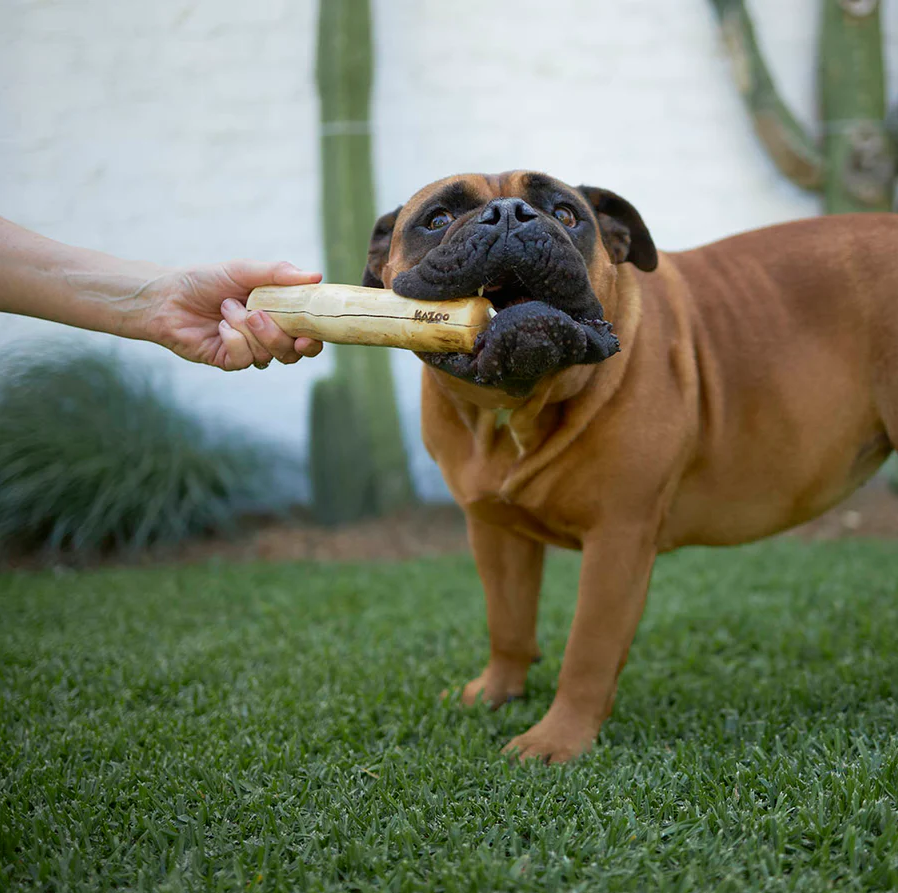
Coffee wood chew sticks are growing rapidly in European and US pet specialty retail. Indonesia is one of the world's largest coffee producers, and the sticks are derived from wood that would otherwise be discarded - a circular economy story that resonates strongly with sustainability-focused buyers and independent retail channels.
Play Trail works with a subset of these suppliers directly, which matters when buyers need to present actual documentation to retail partners rather than a manufacturer's self-reported claims.
Indonesia–US Trade Agreement 2026
Indonesia finalized a reciprocal trade agreement with the US on February 19, 2026, signed by Presidents Prabowo and Trump in Washington. The deal set a 19% tariff baseline and secured exemptions on a range of goods including natural rubber and coffee - categories directly relevant to pet toy materials. Current Section 122 tariffs of 10% apply until approximately July 2026. Indonesia's effective tariff rate in late 2025 was running at 19.7% - the highest of the major ASEAN trading partners - so the new deal's exemptions represent a meaningful win for natural-material product lines.
Labor costs in Central Java average around $130/month, among the lowest in the region.
Indonesia Pet Toy Supplier Limitations
Production volumes and lead times are not comparable to Vietnam. For high-volume, standardized production, Vietnam remains better positioned. Go in with realistic expectations on capacity and turnaround.
Best fit for: Natural material toys, artisanal and handcrafted products, sustainable pet toys, premium independent retail and DTC channels.
Pet Toy Import Regulations: US and EU Compliance Guide (2026)
Most brands entering Southeast Asian pet toy sourcing for the first time are surprised by the same thing: there is no federal safety standard for pet toys in the United States. The CPSC has publicly acknowledged it lacks the mandate and resources to regulate pet products unless a human is injured. The FDA only intervenes when a product is marketed as edible.
This doesn't mean the regulatory environment is simple - it means compliance is fragmented across state laws, retailer requirements, and international regulations, with serious financial consequences for getting it wrong.
US Pet Toy Import Regulations
California Proposition 65 is the single most consequential US regulation for pet toy imports. Prop 65 covers 900+ chemicals, imposes penalties up to $2,500 per day per violation, and is actively enforced by private plaintiff firms that screen consumer products for violations. Any brand selling in the US effectively must comply - California's market size makes it unavoidable. Play Trail tracks OEHHA updates to the Prop 65 chemical list as a standing part of its compliance monitoring, since what passes testing today may require reformulation after a list update.
ASTM F963-23 is the US toy safety standard formally mandated by the CPSC in 2024. While this mandate applies to children's toys rather than pet toys, F963-23 continues to function as the practical industry benchmark for pet products. Amazon, Walmart, PetSmart, and Petco require third-party test reports against this standard as a vendor qualification condition. Brands not testing it get flagged at retail qualification.
ASTM WK85577 is the first dedicated dog toy safety standard, currently in development by ASTM Subcommittee F15.05 on Pet Products - a project led by BARK's Director of Safety and supported by 114 members from 86 companies across 10 countries. As of early 2026, the standard has not yet been published. When it does, expect it to become a retailer requirement within 12–18 months. Brands already testing against F963-23 will have a meaningful head start.
Stuffing content labeling laws in 31+ states require labeling on plush products - including plush pet toys - with a Uniform Registry Number. This catches a significant number of first-time importers because it's state-level and because plush pet toys aren't intuitively categorized as stuffed products in a regulatory sense.
Reese's Law, enacted August 2022, applies to products with electronic components and imposes strict requirements around accessible button cell batteries. This is relevant for any smart or interactive pet toy.
EU Pet Toy Import Regulations
The General Product Safety Regulation (GPSR) 2023/988 became fully applicable in December 2024 and is now active enforcement territory. It requires technical documentation, full supply chain traceability, and a designated EU-based responsible person for any non-EU manufacturer. If you're exporting from Vietnam or Thailand into the EU, you need a named legal entity in Europe accepting responsibility for the product before it reaches shelves. EU product recalls reached a record 14,484 events in 2024 - if you haven't established your EU responsible person structure yet, this is an immediate priority, not a future one.
REACH chemical restrictions set key thresholds for pet toys: phthalates at or below 0.1% by weight, lead at or below 0.05%, cadmium at or below 0.01% in plastics, PAHs at or below 0.5 mg/kg in rubber and plastic components, and formaldehyde at or below 75 mg/kg in skin-contact textiles. The SVHC candidate list exceeds 200 substances and expands regularly - compliance requires ongoing monitoring, not a one-time exercise.
UK REACH runs separately under the Health and Safety Executive and is diverging from EU substance restrictions. The UK accepts CE marking under the 2024 Product Safety amendment, but brands selling into both markets should budget for separate compliance tracking.
Sustainability Certifications for Pet Toys: What Importers Need in 2026
The eco-friendly pet toy market was valued at $1.65 billion in 2024 and is projected to reach $3.1 billion by 2035. Major retail buyers are increasingly treating environmental certifications as vendor qualification requirements rather than premium-tier differentiators.
The certifications that matter vary by material. For wood-based products, FSC certification is increasingly required by major retail buyers. For textiles and soft materials like plush and rope toys, OEKO-TEX Standard 100 is the benchmark. Brands making recycled content claims need Global Recycled Standard (GRS) certification to back them up. ISO 14001 covers environmental management at the factory level and signals a broader commitment beyond individual materials. For Indonesian wood products specifically, SVLK timber legality certification is a baseline requirement for credible supply chain documentation.
The EU Deforestation Regulation 2023/1115 adds an upstream documentation requirement: brands must prove that wood and rubber raw materials do not originate from deforested land, pushing supply chain documentation requirements all the way back to the plantation or forest source.
Southeast Asia's natural material advantages are genuine. Thailand's rubber is renewable, biodegradable, and inherently free of BPA and phthalates. Vietnam's wooden toy sector includes FSC-certified manufacturers operating solar-powered facilities. Indonesia's coffee wood and coconut fiber products carry built-in sustainability narratives with strong traction in independent retail and DTC channels.
If sustainability is part of your brand positioning, build it into factory qualification criteria from the first conversation - retrofitting supply chain documentation after production begins is expensive and slow.
How to Vet and Qualify Pet Toy Suppliers in Southeast Asia
Finding a factory in Southeast Asia is straightforward. Finding one that consistently meets quality specifications, passes third-party chemical testing, satisfies retailer documentation requirements, and delivers on time without subcontracting to unaudited facilities is a different problem.
Common audit failures in the region include quality management systems that exist on paper but aren't followed in practice, unannounced subcontracting to secondary unaudited facilities, poor material traceability, and training gaps that produce elevated defect rates on complex assemblies.
Around 20% of Indonesian toy production fails safety standards on first inspection. Vietnam shows similar variation between top-tier export factories and smaller suppliers. These aren't edge cases - they're predictable failure modes in markets where buyers are working from trade directories rather than verified supplier relationships obtained through trusted sourcing partnerships.
Priority certifications for supplier selection include ISO 9001 for quality management, BSCI or SMETA for social compliance, REACH compliance documentation for chemical safety, and ASTM F963-23 or EN 71 test reports - voluntary but expected by major retailers.
What Certifications Do Pet Toy Manufacturers in Vietnam Need?
The baseline expectation for any Vietnamese factory supplying major US or EU retailers includes ISO 9001, a BSCI or SMETA social audit, REACH compliance documentation covering relevant substances, and third-party test reports against ASTM F963-23. Factories targeting EU markets also need to support their buyers' GPSR documentation requirements, including full supply chain traceability. Certification status should be treated as a qualification criterion, not something verified after a factory is selected.
Frequently Asked Questions: Pet Toy Sourcing in Southeast Asia
Is Vietnam or China better for pet toy manufacturing in 2026?
Vietnam is generally the better choice in 2026, offering labor costs roughly half those of China and a 20% US tariff baseline versus China's 30%+ effective rate. Chinese goods currently face a 30% US tariff rate, with ongoing Section 301 investigations that could push rates higher. That said, the tariff environment is actively shifting - brands should model multiple scenarios rather than locking in assumptions about tariff rates for the next 12–24 months.
What are the current US tariff rates for pet toys from Southeast Asia?
As of March 2026, a 15% Section 122 tariff applied globally, stacked on existing MFN rates, following the Supreme Court's February 2026 ruling that struck down the IEEPA tariffs. This rate is in effect for approximately 150 days through July 2026. Vietnam's bilateral framework targets a 20% baseline; Thailand and Indonesia are at 19%. New Section 301 investigations initiated in March 2026 cover all three countries and could result in higher country-specific rates later in 2026. Importers should treat current rates as transitional.
What safety certifications are required for pet toys sold in the US?
There is no mandatory federal safety standard specifically for pet toys. In practice, major retailers including Amazon, Walmart, Petco, and PetSmart require third-party testing against ASTM F963-23 as a vendor qualification condition. California Proposition 65 compliance is effectively mandatory for any brand selling at national retail. The first dedicated dog toy standard, ASTM WK85577, is still in development as of early 2026 and is expected to become a retailer requirement within 12–18 months of publication.
Which country in Southeast Asia is best for natural rubber pet toys?
Thailand is the strongest option, as the world's largest natural rubber producer at approximately 36% of global output. For latex chew toys, rubber fetch toys, or any rubber-intensive product line, Thai sourcing offers a raw material advantage no other country in the region can match.
What is ASTM WK85577?
ASTM WK85577 is the first international safety standard specifically developed for dog toys, currently in development by ASTM Subcommittee F15.05 on Pet Products. It is led by BARK's Director of Safety and supported by 114 members across 86 companies and 10 countries. As of early 2026 the standard has not yet been published. When it does publish, it is expected to become a major retailer requirement within 12–18 months - making it the most significant pending development in pet toy regulation for brands sourcing from Southeast Asia.
What is the EU's GPSR and how does it affect pet toy imports?
The EU General Product Safety Regulation (GPSR) 2023/988 became fully applicable in December 2024 and is now actively enforced. It requires complete technical documentation, supply chain traceability, and a named EU-based responsible person for any non-EU manufacturer. Brands exporting from Southeast Asia into the EU that have not yet established their EU responsible person structure are out of compliance today.
Are Indonesian pet toy manufacturers reliable for export?
Indonesian manufacturers are well-suited to natural material products - coffee wood, liana, bamboo, coconut fiber - and serve premium retail and DTC channels effectively. Indonesia finalized a trade agreement with the US in February 2026 that secured exemptions on natural rubber and coffee-related goods, which is directly relevant to coffee wood chew products. For high-volume standardized production, Vietnam remains better positioned. Expect longer lead times and lower maximum volumes from Indonesian suppliers compared to Vietnamese equivalents.
Are coffee wood chew sticks safe for dogs?
Coffee wood chew sticks are generally considered safe for dogs and have gained significant traction in European and US pet specialty retail over the past several years. They are made from the wood of pruned or discarded coffee trees - not the coffee bean itself - and do not contain caffeine in quantities associated with harm. As with any chew product, appropriate sizing for the dog's breed and supervision during chewing apply. Indonesian manufacturers producing coffee wood chews for export markets typically hold SVLK timber legality certification, which speaks to material sourcing rather than product safety specifically. Brands commercializing these products should conduct standard chemical testing as part of their compliance process.
About Play Trail
Play Trail works with pet toy and collectible brands sourcing from Southeast Asia - based in Vietnam, with an active supplier network in Thailand and Indonesia.
We track the regulatory and tariff environment - Prop 65 updates, REACH SVHC list additions, retailer standard revisions, and the rapidly shifting US trade policy picture - so brands don't have to maintain that expertise internally. And we match product categories to the right manufacturing ecosystem: plush and rope toys from Vietnam, rubber and latex toys from Thailand, natural and artisanal products from Indonesia.
The tariff volatility of 2025–2026 has added a layer of complexity to Southeast Asia sourcing that didn't exist two years ago. Brands that built supplier relationships and compliance infrastructure before the disruption are navigating it better than those who didn't. The same logic applies now - the brands that get factory qualification and documentation right today will be better positioned when tariff policy stabilizes, whenever that is.
Get in touch with Play Trail to start planning your next production line expansion.
At PLAY TRAIL, we specialize in delivering end-to-end design, supply chain and manufacturing solutions that are tailored to meet your unique business objectives in toys and toys packaging production in Vietnam and Southeast Asia.
Let us help you simplify your supply chain, improve operational efficiency, and build a sustainable future. Our hands-on team is here to provide expert guidance and actionable insights that drive tangible results for your business.
Get in Touch Today
Whether you need assistance with sourcing, logistics, or end-to-end supply chain management, we’re here to help.
Contact us today for a free quote to make the right, optimal decisions for your business growth.